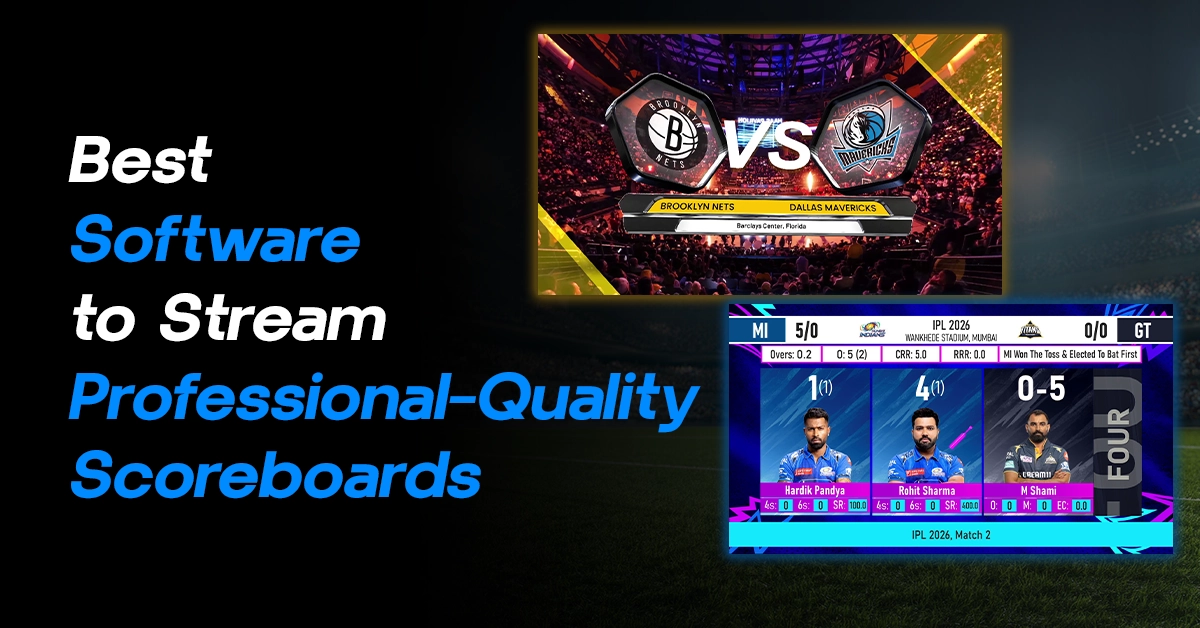
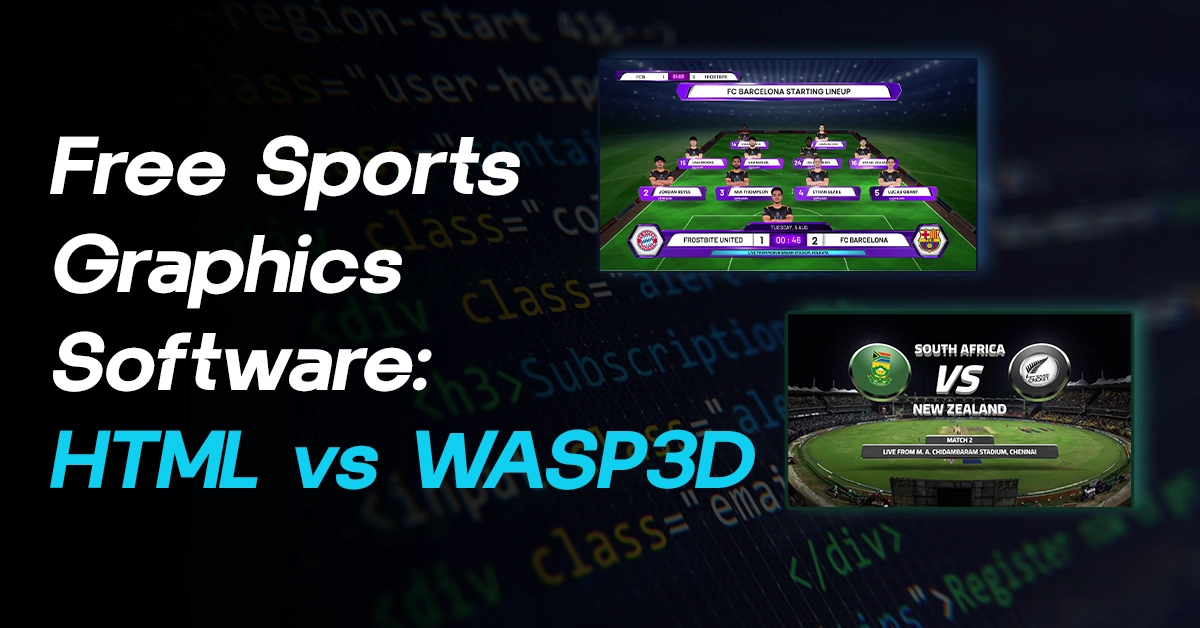
Live sports have evolved far beyond simply showing the action on the field. Today’s audiences expect dynamic scoreboards, real-time player statistics, animated graphics, sponsor branding, and instant match updates that enhance every moment of the game. Whether viewers are watching television, YouTube, OTT platforms, or social media, live graphics for sports broadcasts have become an essential part of delivering professional and engaging viewing experience.
Behind every successful sports broadcast is a combination of advanced technologies working together. Sports graphics software transforms raw match data into visually appealing graphics, while streaming solutions ensure the production reaches audiences across multiple platforms with minimal latency. Automated data integration, real-time scoreboard graphics, and seamless production workflows help broadcasters reduce manual work and focus on delivering compelling coverage.
Whether you’re a regional broadcaster, sports production company, eSports organizer, or professional league, choosing the right tools can significantly improve production efficiency and viewer engagement. This guide explores the technologies, workflows, and software behind live graphics for sports broadcasts, helping you understand how modern productions create immersive experiences using sports graphics software, scoreboard graphics, live streaming, and professional production solutions.
What Are Live Graphics for Sports Broadcasts?
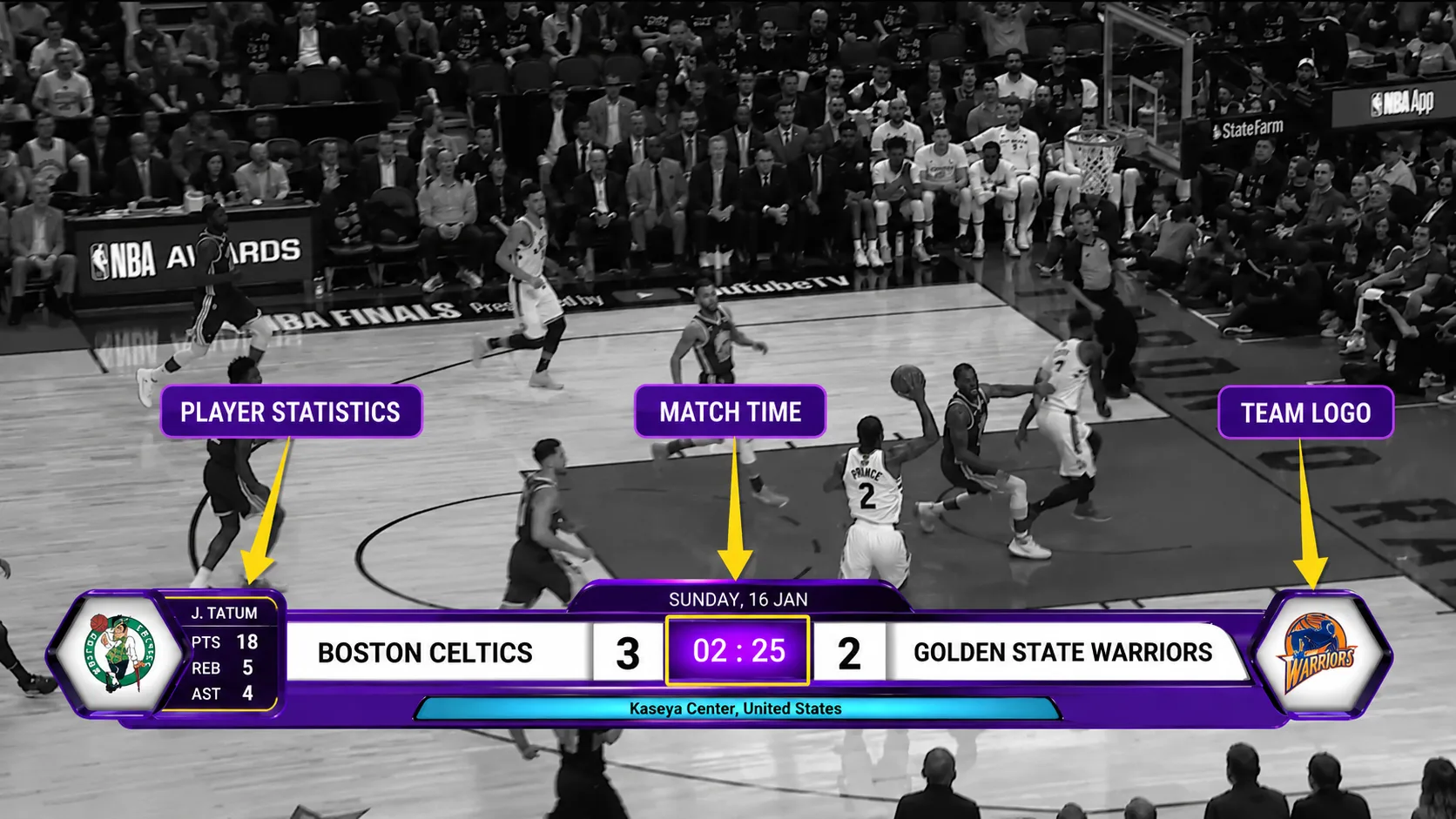
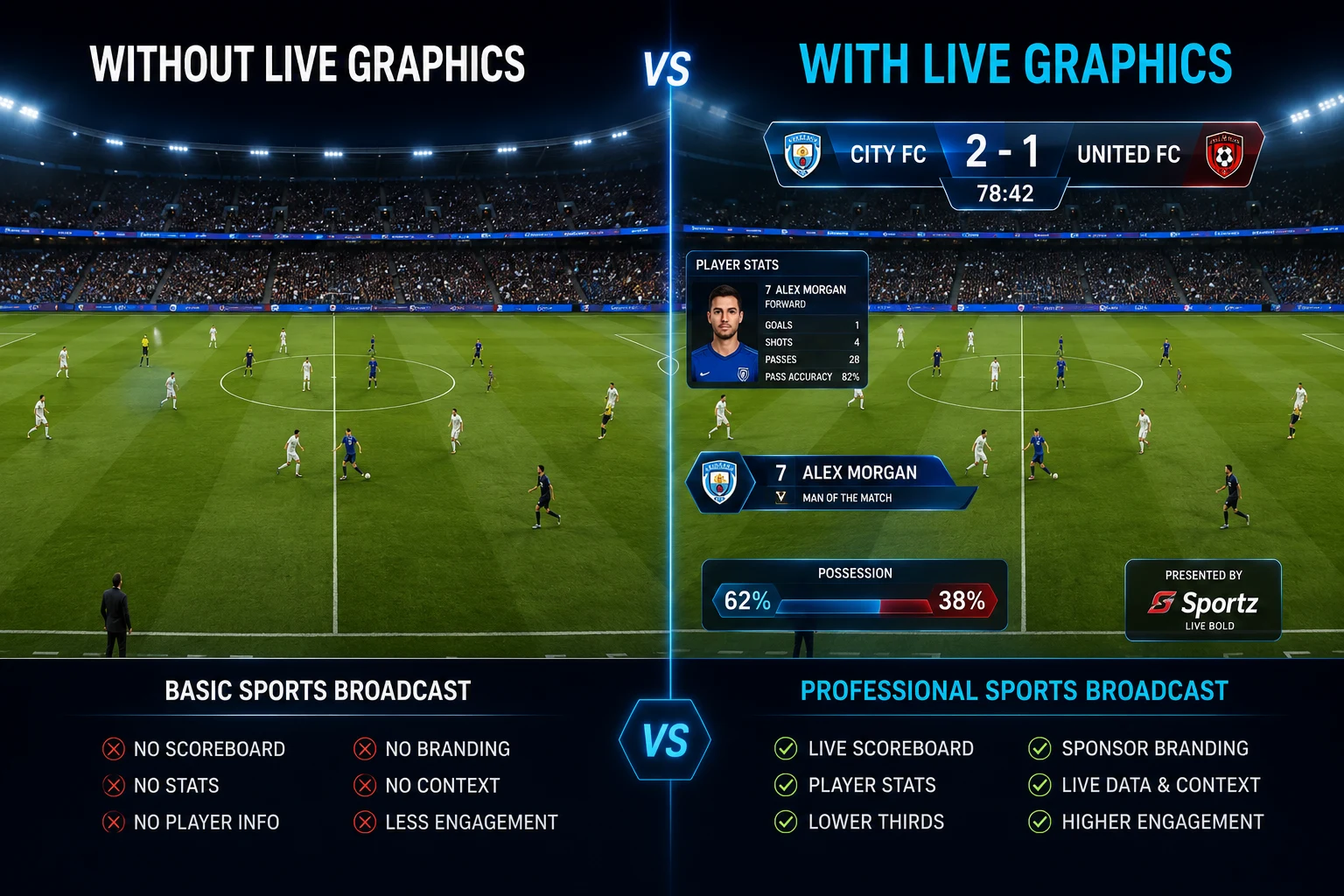
Live graphics are the visual elements displayed alongside live sports coverage to provide viewers with real-time information before, during, and after a match. Instead of relying solely on commentators, broadcasters use graphics to present scores, player statistics, match clocks, team lineups, sponsor branding, and other critical information that helps audiences follow the action more easily.
As sports broadcasting has evolved, these graphics have become increasingly intelligent. Modern solutions automatically update scores, retrieve player data from live databases, and generate broadcast-quality animations within seconds. This not only improves the viewing experience but also allows production teams to manage complex broadcasts more efficiently.
Today, live graphics for sports broadcasts play a central role across television networks, streaming platforms, OTT services, and digital sports productions. They help broadcasters present information clearly while maintaining a consistent visual identity throughout the event.
See How to Create Professional Sports Graphics Without Coding
Understanding the different types of live graphics is only the first step. The next challenge is creating broadcast-ready graphics that look professional without spending hours designing them or writing code.
If you’re using OBS Studio or vMix for sports broadcasting, the tutorial below shows how to create professional sports graphics without HTML or programming knowledge. It’s an excellent starting point for broadcasters, streamers, sports clubs, and production teams looking to build engaging live broadcasts quickly.
Video:
Why Live Graphics Matter in Modern Sports Productions
Every second matters during a live sporting event. A delayed score update or missing player statistic can reduce the quality of the broadcast and affect the viewer’s experience. Live graphics eliminate these challenges by providing accurate, real-time information that keeps audiences engaged throughout the match.
Professional broadcasters use live graphics to:
- Display live scores and match clocks
- Introduce teams and players
- Highlight player statistics and performance metrics
- Present sponsor branding and advertisements
- Showcase tournament standings and fixtures
- Deliver animated lower thirds and information panels
- Enhance storytelling during pre-match, halftime, and post-match analysis
When combined with reliable streaming and production workflows, these graphics help create broadcasts that are both informative and visually engaging.
Core Components of Live Sports Broadcast Graphics
Modern sports productions rely on multiple graphic elements working together to create a seamless broadcast.
Live Scoreboards
Scoreboards are among the most recognizable graphics in any sports broadcast. They display scores, timers, match periods, player fouls, overs, innings, possession indicators, or other sport-specific information, updating continuously as the game progresses.
Player Statistics
Real-time player statistics provide viewers with valuable insights into individual and team performance. Depending on the sport, broadcasters may display goals, assists, batting averages, wickets, passing accuracy, possession percentages, or other performance metrics.
Team Lineups
Before a match begins, team lineup graphics introduce starting players, substitutes, formations, and coaching staff. These graphics help audiences quickly understand team compositions before the action starts.
Lower Thirds
Lower thirds identify commentators, players, coaches, referees, and special guests throughout the broadcast. Animated lower thirds also communicate important announcements, substitutions, injuries, and match updates.
Match Clocks and Timers
Whether it’s football, cricket, basketball, hockey, or eSports, timers are essential for keeping viewers informed about match progress. Accurate clocks improve both the viewer experience and broadcast professionalism.
Sponsor Graphics
Sports broadcasts often include sponsor logos, branded transitions, advertising panels, and promotional graphics. Integrating sponsor branding into live graphics helps broadcasters maximize commercial opportunities while maintaining a polished presentation.
Data-Driven Graphics
Modern sports graphics software can automatically transform live match data into broadcast-ready visuals. Instead of manually updating every graphic, broadcasters can connect to APIs or databases that generate dynamic player comparisons, statistics, leaderboards, and match analytics in real time.
Live Streaming Integration
Graphics alone cannot deliver a successful broadcast they must work alongside professional streaming workflows. Integrating graphics with streaming software ensures viewers receive synchronized visuals, live updates, and a consistent experience across television, OTT platforms, YouTube, Facebook Live, and other streaming services.
Essential Tools for Creating Live Graphics for Sports Broadcasts
Producing professional live graphics for sports broadcasts requires more than creative design. Behind every successful sports production is a combination of specialized tools that manage graphics, scoreboard automation, live data, video production, and streaming. When these tools work together, broadcasters can deliver engaging coverage while reducing manual effort during fast-paced live events.
Sports Graphics Software
Sports graphics software forms the foundation of modern sports broadcasts. It enables production teams to create visually appealing graphics that communicate essential match information in real time.
Common graphics created using sports graphics software include:
- Animated lower thirds
- Player profiles
- Team lineups
- Match statistics
- Sponsor branding
- Tournament graphics
- Pre-match and halftime visuals
- Dynamic information panels
Professional solutions also support real-time data integration, allowing graphics to update automatically as match events unfold instead of requiring manual intervention.
Scoreboard Graphics Systems
Scoreboard graphics are among the most important visual elements in any sports production. Viewers rely on them to stay informed throughout the event, making accuracy and speed essential.
Modern scoreboard graphics systems can display:
- Live scores
- Match timers and clocks
- Team names
- Player information
- Possession indicators
- Fouls and penalties
- Innings, overs, or sets depending on the sport
When connected to live data sources, these systems automatically update the graphics throughout the match, reducing the risk of manual errors and ensuring viewers always see the latest information.
Live Video Production Software
While graphics provide information, live video production software manages the visual flow of the broadcast. Production teams use these tools to combine multiple camera feeds, switch between different shots, and create professional viewing experiences.
Typical capabilities include:
- Multi-camera production
- Picture-in-picture layouts
- Live transitions
- Video routing
- Remote production workflows
- Source management
By integrating graphics with video production software, broadcasters can synchronize visual storytelling with every key moment of the game.
Sports Streaming Software
Today’s audiences watch sports across multiple devices and platforms. Professional sports streaming software helps broadcasters distribute content reliably while maintaining high video quality and low latency.
Modern streaming solutions support:
- Multi-platform streaming
- RTMP streaming
- SRT streaming
- NDI workflows
- SDI workflows
- OTT delivery
- YouTube Live
- Facebook Live
- Broadcast television distribution
Reliable streaming software ensures that graphics, video, and live data remain synchronized across every platform, delivering a consistent viewing experience regardless of where audiences choose to watch.
How Live Graphics Work During a Sports Broadcast
Creating professional live graphics for sports broadcasts involves much more than designing attractive overlays. During a live event, multiple systems work together to capture video, process live data, generate graphics, and stream the final production to viewers across different platforms.
A well-integrated workflow allows production teams to update graphics instantly, manage multiple camera feeds, and deliver a seamless viewing experience without interrupting the live action.
In this workflow, cameras capture the live action while Fluid DVE manages video sources and streams the production to multiple destinations. At the same time, WASP3D PRO generates dynamic graphics using real-time match data, ensuring scoreboards, player statistics, and other on-screen elements remain accurate throughout the event.
Because these systems work together, broadcasters can deliver professional sports productions with minimal delays and significantly fewer manual updates.
What Tools Are Used for Creating Detailed Sports Breakdowns and Media Content?
Modern sports coverage extends well beyond the live match itself. Broadcasters also produce pre-match shows, halftime analysis, post-match reviews, player comparisons, and social media content that help audiences understand the game in greater detail. Creating this content requires software capable of transforming live data into visually engaging graphics quickly and accurately.
Instead of manually designing each graphic, professional broadcasters use solutions that automate data visualization while maintaining a consistent on-air look across every production.
WASP3D PRO for Professional Sports Graphics
For broadcasters covering professional leagues, tournaments, and major sporting events, WASP3D PRO provides a comprehensive platform for creating data-driven sports graphics.
Its ability to connect with live data sources enables production teams to generate broadcast-quality graphics automatically as match events unfold.
Key capabilities include:
- Live API integration for real-time sports data
- Dynamic player statistics and performance graphics
- Automated scoreboard graphics
- Match analytics and team comparisons
- Animated lower thirds
- User Defined Tables (UDTs) for customized production workflows
- XML, JSON, SQL, RSS, and API connectivity
Rather than manually updating every statistic or scoreboard, production teams can automate repetitive tasks while ensuring graphics remain accurate throughout the broadcast. This is particularly valuable for high-pressure sporting events where information changes every few seconds.
Whether displaying batting statistics during a cricket match, player heat maps in football, or team comparisons in basketball, WASP3D PRO enables broadcasters to present complex information in a format that is easy for viewers to understand.
What Are the Best Tools for Creating Play-by-Play Content?
Play-by-play coverage is one of the most demanding aspects of sports broadcasting. Every goal, wicket, basket, touchdown, substitution, or timeout must be communicated to viewers immediately through clear and accurate graphics.
To achieve this, broadcasters need software capable of processing live match data, generating graphics in real time, and delivering reliable broadcasts across multiple viewing platforms.
An integrated production workflow makes it possible to present every key moment without disrupting the pace of the game.
Real-Time Scoreboard Graphics with WASP3D PRO
A professional scoreboard is the foundation of every live sports broadcast. It provides viewers with the essential information they need while allowing commentators to focus on the action rather than repeatedly announcing match details.
With WASP3D PRO, broadcasters can create dynamic scoreboard graphics that automatically update using live data connections.
These scoreboards can display:
- Live scores
- Match clocks and timers
- Team names
- Player information
- Tournament branding
- Fouls, overs, innings, or period details
- Sport-specific match information
Because the graphics update automatically through connected data sources, production teams can reduce manual operations while improving overall broadcast accuracy.
Dynamic Player Statistics and Match Graphics
Modern audiences expect access to detailed player and team statistics throughout the broadcast. Whether comparing batting averages, possession percentages, shooting accuracy, or player rankings, dynamic graphics help explain the story behind the game.
WASP3D PRO transforms live sports data into visually engaging graphics that include:
- Player comparison panels
- Team performance graphics
- Match statistics
- League standings
- Performance trends
- Data-driven lower thirds
Since these graphics are generated from real-time data, broadcasters can deliver up-to-date information without interrupting the live production workflow.
Fluid DVE for Professional Sports Streaming
A successful sports broadcast depends not only on high-quality graphics but also on reliable content delivery. Audiences expect smooth, uninterrupted streaming regardless of the platform they use.
Fluid DVE is designed to simplify professional sports streaming by enabling broadcasters to distribute live productions across multiple destinations from a single workflow.
Its streaming capabilities include:
- Multi-platform live streaming
- RTMP streaming support
- SRT streaming for secure, low-latency delivery
- Simultaneous streaming to multiple platforms
- Integration with television, OTT services, YouTube, Facebook Live, and other streaming destinations
By supporting modern streaming protocols alongside professional production workflows, Fluid DVE helps broadcasters reach larger audiences while maintaining consistent video quality throughout the event.
Although Fluid DVE also supports live video production and switching, its greatest strength lies in helping broadcasters manage reliable, scalable sports streaming across today’s diverse media landscape.
End-to-End Sports Production Workflow
Professional sports productions are most effective when graphics, data, video, and streaming work together as one integrated system.
By combining WASP3D PRO with Fluid DVE, broadcasters can build a streamlined workflow that includes:
- Automated live graphics
- Real-time sports data integration
- Professional scoreboard graphics
- Multi-platform live streaming
- Broadcast-quality production
- Efficient content delivery
- Reduced manual intervention
Instead of relying on disconnected applications, production teams can manage graphics and streaming within a coordinated workflow that improves operational efficiency while delivering a more engaging viewing experience for sports fans.
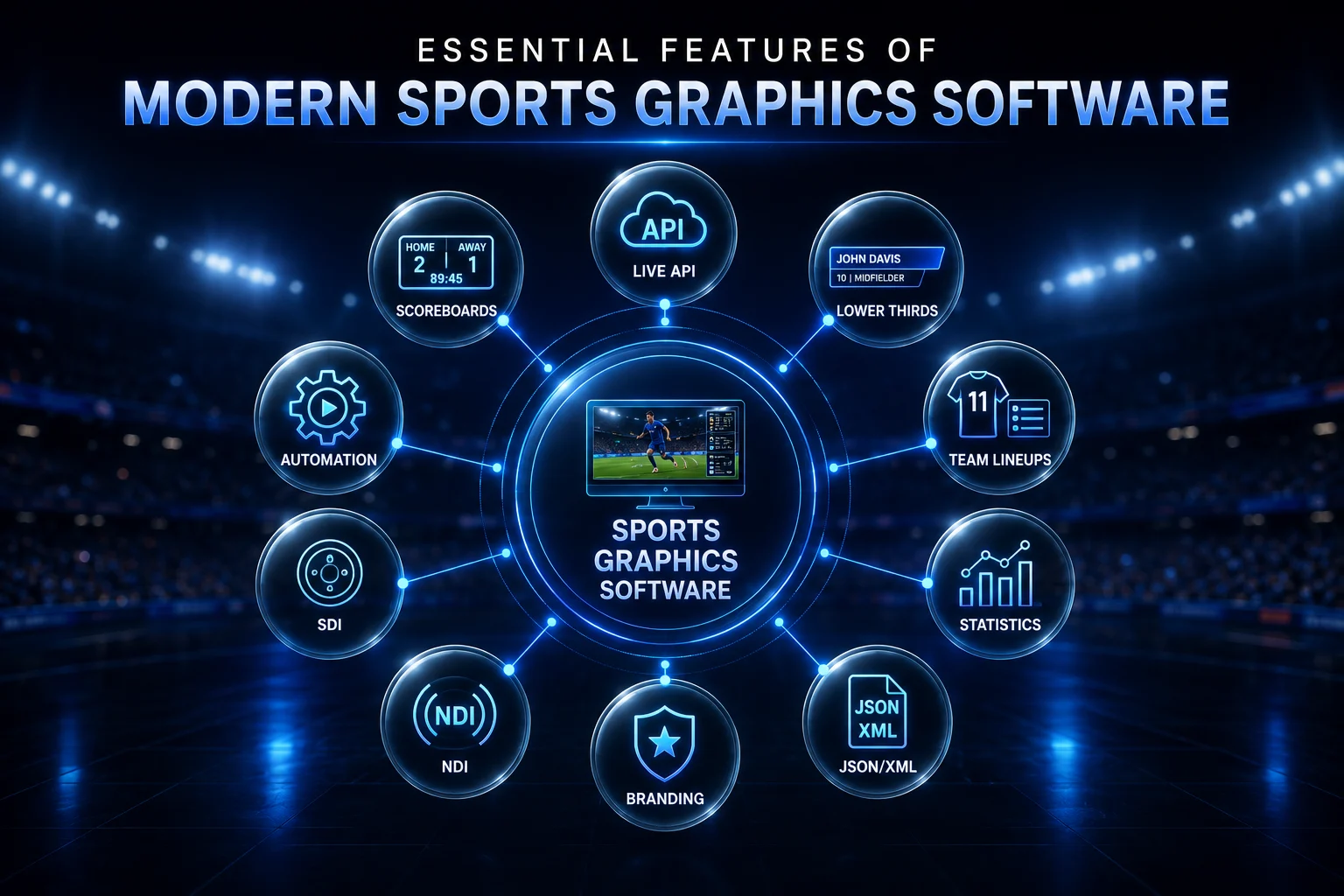
Must-Have Features in Live Graphics Software for Sports Broadcasts
Choosing the right software for live graphics for sports broadcasts goes beyond attractive designs and animated scoreboards. Modern sports productions require solutions that can process live data, automate repetitive tasks, integrate with existing broadcast infrastructure, and deliver high-quality graphics without slowing down production.
Whether you’re producing regional tournaments, professional leagues, or eSports competitions, the following features are essential for building an efficient and scalable sports broadcasting workflow.
See How Animated Scoreboard Numbers Are Created
Smooth scoreboard animations make live sports broadcasts feel more professional and engaging. Instead of static score updates, broadcasters often animate score changes, timers, and match statistics to draw viewers’ attention to important moments without distracting the game.
The following tutorial demonstrates how to animate numbers in a sports scoreboard using free software, making it a great starting point for broadcasters, content creators, and production teams looking to enhance their live graphics.
Video:
Real-Time Graphics Rendering
Sports broadcasts happen in real time, and graphics must keep pace with every moment of the game. Professional graphics software should render scoreboards, lower thirds, player statistics, and match information instantly without affecting broadcast quality.
Fast rendering ensures viewers receive timely updates while maintaining a smooth viewing experience.
Live Data Integration
Manual graphic updates are time-consuming and increase the likelihood of errors. Modern graphics solutions integrate directly with live sports databases and scoring systems to automate updates throughout the match.
This allows broadcasters to display:
- Live scores
- Player statistics
- Match events
- Tournament standings
- Team comparisons
without manually editing each graphic.
API Connectivity
Every sports organization manages data differently. A flexible graphics solution should support API connectivity and multiple data formats so broadcasters can integrate with existing scoring platforms and management systems.
Support for JSON, XML, SQL, RSS, and APIs enables production teams to automate graphics while reducing manual operations.
Scoreboard Automation
Professional scoreboard graphics should update automatically as the match progresses. Automated scoreboards improve production efficiency and ensure viewers always receive accurate information during fast-paced sporting events.
Template-Based Workflows
Reusable templates help broadcasters maintain consistent branding while reducing graphic creation time. Production teams can quickly customize player information, team names, sponsor logos, and match details without rebuilding graphics for every event.
Custom Branding
Every broadcaster has its own visual identity. Modern graphics software should allow complete customization of colors, fonts, animations, logos, and layouts so broadcasts remain consistent across television, streaming platforms, and social media.
Remote Production Support
Remote production has become increasingly common, allowing teams to collaborate from different locations. Software that supports remote workflows helps broadcasters manage graphics and production more efficiently while reducing travel and infrastructure costs.
NDI and SDI Compatibility
Broadcast environments often combine traditional SDI infrastructure with modern IP-based workflows. Supporting both standards provides greater flexibility when integrating graphics into existing production systems.
Multi-Platform Streaming
Today’s audiences consume sports content across multiple platforms. Broadcasters should look for solutions that support simultaneous streaming to television, OTT platforms, YouTube, Facebook Live, and other digital destinations without requiring separate workflows.
Common Challenges in Live Sports Production and How Modern Graphics Software Solves Them
Live sports broadcasting presents unique operational challenges. Production teams must process large volumes of information while responding instantly to changes on the field. Without the right tools, even small delays can affect the overall quality of the broadcast.
Delayed Graphics Updates
Updating graphics manually can result in delayed scores, outdated player information, or incorrect match statistics.
Solution: Automated data integration ensures graphics update in real time, reducing manual work and improving broadcast accuracy.
Manual Score Updates
Entering scores manually throughout a match increases the risk of production errors, particularly during fast-paced games.
Solution: Automated scoreboard systems synchronize with live match data, keeping scoreboards accurate without requiring constant operator input.
Complex Production Workflows
Managing graphics, video, streaming, and multiple software applications separately can slow production and increase operational complexity.
Solution: Integrated production workflows simplify operations by connecting graphics generation, data management, and streaming into a unified system.
Last-Minute Player Changes
Player substitutions, lineup adjustments, or injury updates often occur shortly before or during the match.
Solution: Data-driven graphics enable production teams to update player information instantly without redesigning graphics manually.
Streaming Reliability
Sports audiences expect uninterrupted broadcasts regardless of where they watch.
Solution: Professional streaming software with support for RTMP, SRT, NDI, and SDI helps broadcasters deliver reliable streams across television, OTT services, and online platforms.
How to Choose the Right Sports Broadcasting Software
Selecting the right sports broadcasting software depends on the scale of your production, the sports you cover, and your long-term production goals. Rather than focusing on individual features alone, broadcasters should evaluate how well the software integrates into their overall workflow.
When comparing different solutions, consider the following factors:
- Graphics quality and customization
- Real-time data integration
- Automated scoreboard capabilities
- Live streaming support
- Multi-platform distribution
- Ease of use
- Compatibility with existing broadcast infrastructure
- Scalability for future productions
- Technical support and product reliability
Choosing software that combines graphics, data, and streaming capabilities can significantly reduce production complexity while improving efficiency and viewer engagement.
Why WASP3D Is a Complete Solution for Live Graphics for Sports Broadcasts
Producing professional live graphics for sports broadcasts requires more than just attractive overlays. Broadcasters need a solution that can create dynamic graphics, integrate real-time sports data, automate repetitive tasks, and stream live events reliably across multiple platforms.
WASP3D PRO and Fluid DVE provide an integrated workflow that addresses these requirements. It focuses on intelligent graphics creation and live data integration, along with ensuring that productions are streamed efficiently to television, OTT platforms, and online audiences.
Conclusion
The expectations of today’s sports audiences continue to grow. Viewers no longer watch broadcasts solely to follow the score they expect real-time statistics, dynamic graphics, professional storytelling, and seamless streaming across every device.
This is why live graphics for sports broadcasts have become an essential component of modern sports production. From automated scoreboards and player statistics to multi-platform streaming and data-driven graphics, the right technology enables broadcasters to deliver engaging experiences while improving production efficiency.
For broadcasters looking to modernize their workflows, combining intelligent graphics with reliable streaming creates a powerful production ecosystem. Solutions like WASP3D PRO simplify graphics creation through live data integration and automation, while Fluid DVE ensures those productions reach audiences through scalable, professional streaming workflows.
As live sports production continues to evolve, investing in integrated technologies will help broadcasters produce faster, smarter, and more engaging broadcasts that keep viewers connected to every moment of the game.