Introduction: Scoreboards Are a System, Not a Layer
If you have ever watched a live match where the score appeared late or showed the wrong value, you already understand how quickly trust breaks. Even if everything else in the stream looks good, one small delay in the scoreboard can make the entire production feel unprofessional.
This is why scoreboards are no longer just visual elements placed on top of a video. Today, they are part of a much larger system. When we talk about the Best Sports Graphics Software, we are not just talking about design tools. We are talking about complete systems that handle real-time data, logic, and on-air output together.
Behind every smooth scoreboard, there are three things constantly working:
- Data is being entered or received from a source
- Logic is deciding how and when updates should happen
- Graphics are being rendered and shown to the audience
All of this work happens in real time, often within milliseconds. So choosing the best sports graphics software is not about picking something that “looks nice.” It is about choosing something that can perform under pressure, without delays, without errors, and without making the operator struggle during a live match.
Different Games That Use Scoreboards
One of the biggest mistakes people make is assuming that all scoreboards work the same way. Every sport has its own logic, pace, and data complexity. This is where the best sports graphics software truly proves its value it should adapt to different sports, not force you into a fixed structure.
Let’s look at how scoreboards differ across popular sports.
Football Scoreboard (Soccer)
Football scoreboards may look simple, but they are highly time-sensitive. A typical football scoreboard includes a running match clock, team names, scores, and sometimes cards or substitutions.
The key challenge here is accuracy. The timer must never lag, and score updates must appear instantly after a goal. Even a small delay can break the viewing experience. This is why football scoreboard software needs strong real-time synchronization. Learn how to add a football scoreboard in any live stream software.

Cricket Scoreboard
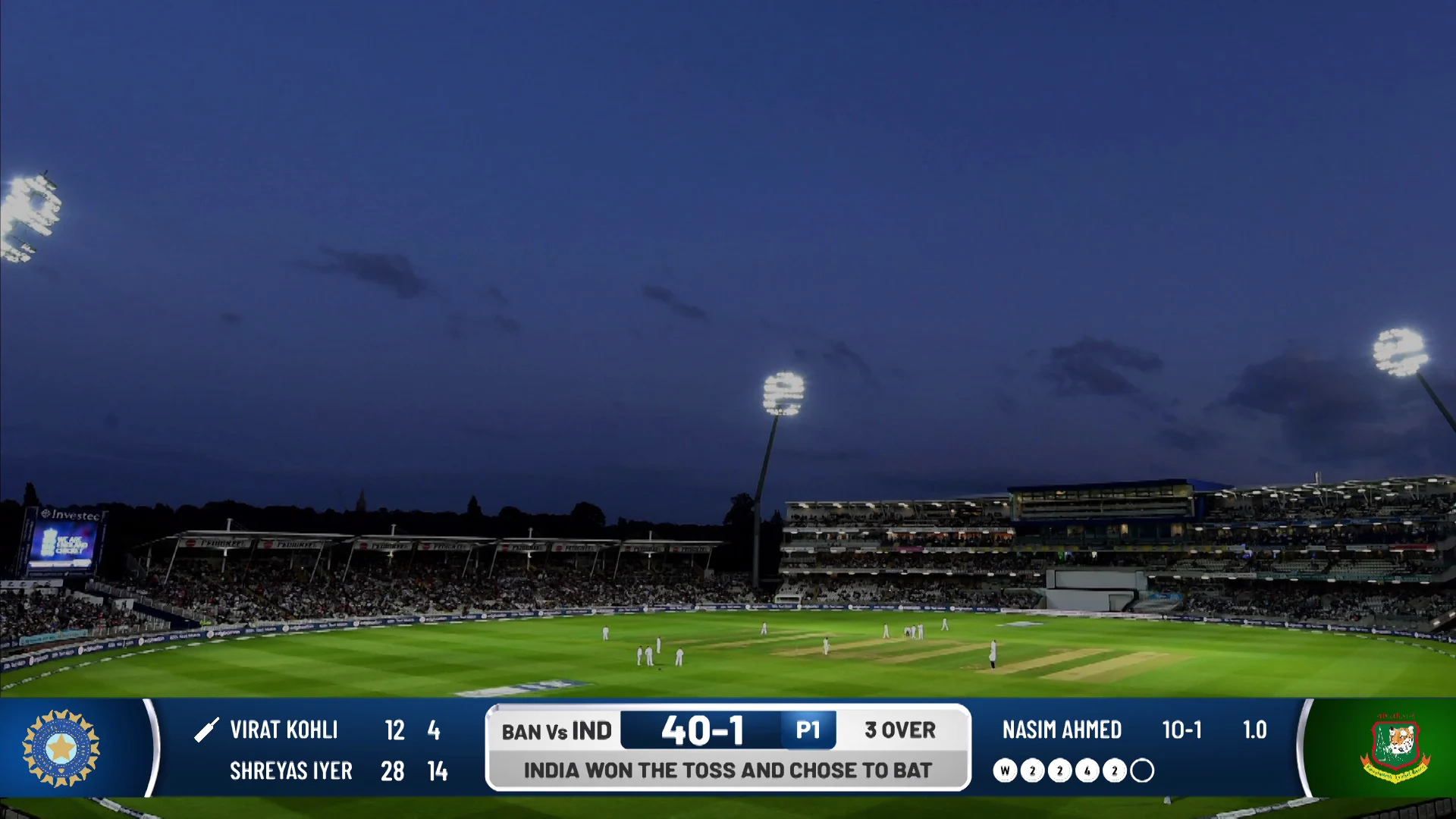
Cricket is one of the most data-heavy sports when it comes to scoreboards. It is not just about runs and wickets. You also have overs, strike rates, partnerships, bowler stats, and different match formats like T20, ODI, and Test.
A cricket scoreboard needs to handle layered data without making the screen look cluttered. It also needs to adapt to different match situations, like powerplays or innings changes. This makes cricket one of the most demanding use cases for any sports graphics system.
Basketball Scoreboard
Basketball is fast and continuous. The scoreboard needs to update frequently and accurately. It includes quarters, shot clocks, fouls, and timeouts.
Unlike football, where updates are occasional, basketball requires constant interaction. The operator cannot afford delays or confusion. This is where low latency and quick controls become very important.

eSports Scoreboard
eSports has completely changed how scoreboards are designed. Unlike traditional sports, every game has its own rules and structure. A scoreboard for a first-person shooter is very different from one for a MOBA game.
You may need to show player stats like kills, deaths, assists, team economy, or even map-specific data. The Best Sports Graphics Software must be flexible enough to support these custom requirements without needing a complete redesign every time.
Tennis Scoreboard
Tennis scoreboards follow a structured scoring system. You need to display sets, games, and points clearly. The challenge here is not speed but logic. The system must correctly handle scoring rules and transitions without errors.
What this shows is simple: there is no “one-size-fits-all” scoreboard. The Best Sports Graphics Software is the one that understands the logic of each sport and adapts accordingly.
What Are the Core Requirements of a Scoreboard Software
When people look for the Best Sports Graphics Software, they often focus on visuals. But in real-world production, performance matters much more than appearance. A beautiful scoreboard that fails during a live match is not useful.
Here are the core requirements that actually define professional scoreboard software.
Real-Time Data Handling
The most important requirement is speed. When a score changes, it must reflect on screen instantly. Whether the data is entered manually or comes from an external source, there should be no visible delay.
Automatic Updates From Data
Modern systems reduce manual work by connecting data directly to graphics. This means when a value changes, the scoreboard updates automatically. This is important because manual updates increase the risk of mistakes, especially during high-pressure moments.
Layouts That Adjust Automatically
A good scoreboard is not static. It should adapt to different match conditions. For example, a cricket scoreboard should change when innings switch, and an eSports layout should adjust based on the game.
No Delay In Showing Updates
Rendering is the process of turning data into visuals. If this process is slow, the entire system feels laggy. The best sports graphics software ensures that updates are smooth and frame-accurate.
Easy And Fast To Use
During a live match, the operator does not have time to manage complex systems. The interface should be simple, clear, and fast. The fewer clicks required to update something, the better the system performs in real conditions.
Works For Multiple Sports
If you are managing multiple sports or events, your software should not require a complete setup every time. It should allow you to reuse templates and adapt quickly.
In simple terms, the Best Sports Graphics Software is the one that works reliably when things get fast, unpredictable, and stressful.
Different Scoreboard Software
There are many tools available when you start looking for the Best Sports Graphics Software, but not all of them are built for the same kind of workflow. Some are designed for large broadcast environments, while others are built for simpler streaming setups. Understanding where each fits helps you make the right choice.
WASP3D Xpress
Traditional scoreboard workflows often involve multiple tools—one for designing graphics, another for data entry, and sometimes additional systems for animation or switching. This fragmentation can slow down production and introduce inconsistencies, especially during fast-paced matches.
Xpress addresses this by functioning as a complete system rather than a single-purpose tool. It allows users to conceptualize, design, and operate sports scoreboards within the same environment. This reduces dependency on external software by re-rendering multiple outputs and simplifies the production pipeline, particularly for small teams or independent creators. Designing 3D Animated Scoreboards
One of the defining aspects of modern sports graphics is the use of depth, motion, and visual hierarchy. Xpress enables the creation of 3D animated scoreboards that go beyond flat overlays. Elements such as team panels, timers, player stats, and transitions can be visually structured to reflect broadcast-quality standards.
Design flexibility plays a key role here:
- Layouts can be customized for different sports formats
- Animations can be applied to transitions, entries, and updates
- Visual themes can be adapted based on leagues, tournaments, or branding requirements
This allows creators to maintain consistency across matches while still adapting to different contexts.
Xpress provides operational control directly within the system:
- Manual or triggered updates for scores and timers
- Control over animation timing and transitions
- Ability to switch between different graphic states without interrupting the live feed
This ensures that the operator remains in control without relying on multiple disconnected interfaces.
WASP3D Pro
The growing importance of data in sports—whether it’s live scores, player statistics, or match analytics—has made real-time updates essential. Pro supports real-time data-driven graphics, enabling scoreboards to update dynamically as new information becomes available. It includes all the features in Xpress while also incorporating live data feeds.
This can include:
- Automated score updates
- Integration with external data sources
- Dynamic text and numerical fields that update without reloading scenes
Such capabilities are particularly useful for leagues, tournaments, and digital platforms where accuracy and speed are critical.
OBS Studio
OBS Studio is one of the most popular tools for live streaming. It is free, easy to use, and supports basic overlays through scenes and sources.
But when it comes to scoreboards, it relies mostly on manual updates or plugins done on a third part system rendering the same graphic multiple times. It lacks built-in data handling, automation, and scalability. As production becomes more complex, managing scoreboards inside OBS can become inefficient.
CasparCG
CasparCG is an open-source graphics solution that offers real-time playout and flexibility. Developers and technical teams use it to build custom workflows.
The main limitation is that it is not plug-and-play. It requires coding, integration, and technical understanding. For teams without development support, this can slow down production.
Singular Live
Singular Live is a cloud-based graphics platform that allows users to create and control overlays through a web interface. It is flexible and works well for online streaming environments.
However, it depends heavily on internet connectivity and browser-based workflows. For more complex scoreboard logic or high-pressure live production, it may require additional setup and careful management.
Conclusion
Scoreboards have come a long way from being simple overlays. Today, they are an essential part of live production systems. They control how information is delivered to the audience and directly impact how professional a stream feels.
Choosing the Best Sports Graphics Software is not about comparing feature lists. It is about understanding how the system performs during real matches. It should be fast, reliable, and easy to use under pressure.
As sports streaming continues to grow, the demand for better scoreboard systems will only increase. Viewers expect accuracy, clarity, and consistency across every match and every platform.
This is why modern solutions are moving toward systems that balance performance and simplicity. Tools like Xpress are built with this approach in mind. They simplify workflows without reducing capability, making it easier to deliver professional-quality scoreboards in any environment. In the end, the best choice is the one that helps you stay in control, even when the game is moving fast.